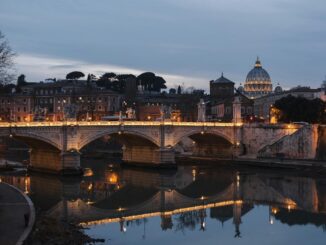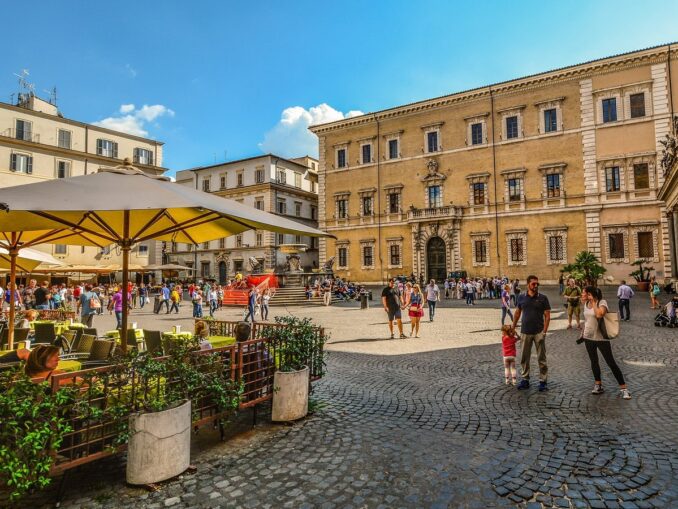
What to see in Rome in 3-5 days or a week on your own, where to go first: with or without children? Main attractions and interesting places, routes, what do you need to know? When is the best time to visit Rome, where to stay, where to go in the surrounding area – in the Eurotraveler review.
Rome is an eternal city. If you think about it, maybe not only because of your age! After all, no matter how much you come here, the feeling of satiety and boredom does not come. Rather, you feel joy. It’s like meeting an old friend you genuinely like.
However, joy is usually characterized by the second and subsequent visits. On the first day, literally every traveler is busy putting thoughts wandering from incredible emotions in relative order.
And the development of routes that make it possible to see interesting places in Rome that are widely known to the respectable public. At the same time, we visited some others, those where tourists do not step on each other’s heels. And the guide’s words don’t sink into the multilingual hubbub…
Best Time to Go to Rome
The correct solution to this issue promises to receive the maximum number of positive impressions. Because, for example, in summer the city is characterized by unhealthy air temperatures (below 40 °C) and an overwhelming number of tourists: both Italians and – especially – foreigners.
It’s still quite hard in the Italian capital either in May and September. The first month of autumn in the Italian capital in terms of the number of hot and clear days, will generally give a head start to some resort on the Mediterranean Sea at the peak of the season.
But it’s not bad here in October: it’s warm and moderately rainy. But tourists are too much – in the second half of the month, school holidays begin in most Western European countries.
Roman November is not bad in terms of temperatures. But the weather during this period can totally ruin a vacation, ruin a day or two – sometimes the rains are so heavy that it’s scary to go outside.
But winter in the Italian capital is the sweetest time. For example, in December, Rome is cool but dry, the city is fit and cheerful, does not even suspect what frosts are.
Here – which months are considered best to come to Rome.
We also recommend that you come to this city in January – outside of public holidays, of course. It is worth traveling here with caution in February – Italian schoolchildren are again given the opportunity to take a break.
It’s definitely worth taking a break in Rome in March, because Western Europeans are working and studying at this time.
But in April, the traditional month of Easter holidays, the “Eternal City” is very crowded again! And most of those who come certainly try to get to St. Peter’s Square to hear the Pope’s festive sermon.
Places of Interest in Rome – Day 1
The Colosseum, an ancient gladiatorial arena that could not be repaired for two millennia, is the central attraction of the city. It comes complete with the Roman Forum and the Palatine Hill, or so it says on the entrance tickets. The inspection will take from noon.
You need to go to the Colosseum metro station. To avoid queues, buy tickets online and for a certain time – ticketing.colosseo.it/en/. However, they are not sold for free via the Internet. So if your group includes people under the age of 18, you will have to pay a visit to the ticket office.
The Palatine ruins adjacent to the Roman Forum are open only from March to October (except Mondays). For example, the Domus Augusti is what remains of the palace of Emperor Augustus.
As well as Museo Palatino, Casa di Livia, Aula Isiaca con Loggia Mattei, Criptoportico Neroniano, Santa Maria Antiqua, Domus Transitoria – all this is visited with a separate ticket.
Guided tours of Nero’s “Golden House”, Domus Aurea, are available only on Saturdays and Sundays. You need to book the time of the visit in advance.
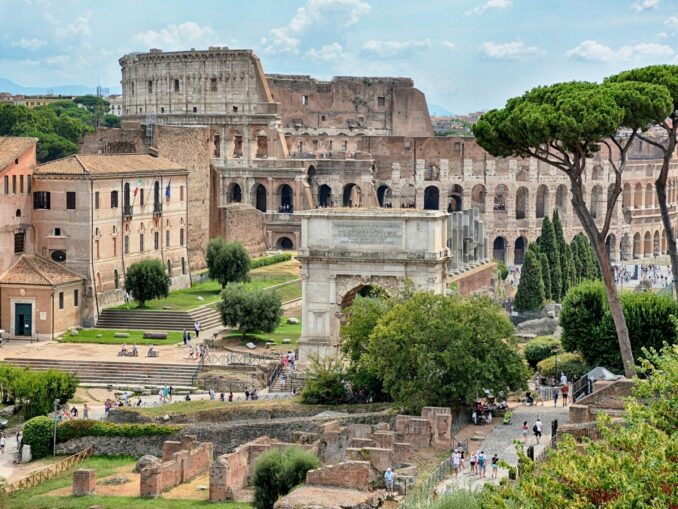
To consolidate your impressions on the first day of exploring Rome, we recommend walking to the majestic Trajan’s column and Caesar’s Forum. For money, you will be provided with a headset, and in the evenings there is a light and music show illustrating the almost fabulous concept called “Ancient Rome.”
The monument to Victor Emmanuel II, a huge white marble structure that is frankly discordant with the neighboring ruins, can be climbed for free. For example, to take a look at the surrounding neighborhoods and assess the size of the Forums.
Inside the “Inkwell” there are small museums: the Risorgimento and the banners of the navy. Which can also be visited in Rome if you have enough free time.
The Capitol
On the other side, Capitol Hill adjoins the memorial. On the northern peak of which stands the church of Santa Maria in Araceli with an amazingly beautiful interior.
Aracheli, by the way, means “Altar of heaven” – how not to enter a temple with such a name?!
The church altar, considered the oldest in the world, features a miraculous icon of the Mother of God, said to have been painted by the Evangelist Luke himself. And in one of the chapels there is a small wooden figure of the Christ Child.
The original, carved from a tree that grew in the Garden of Gethsemane, was stolen. Now a copy is displayed instead.
You can climb directly to the church via the Aracheli stairs, having overcome 124 steps. It was built in 1384 in gratitude for the deliverance of the city from the plague epidemic.
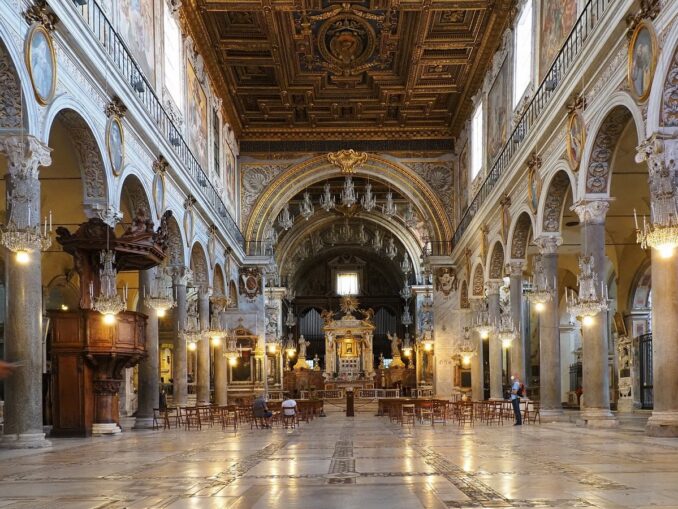
The Cordonata staircase, designed by Michelangelo himself, leads up to the Capitoline Square. And, if you have time, pay a visit to local museums – there are a lot of interesting things on display inside. And, among other things, the famous bronze statue of the she-wolf, who, according to legend, nursed the founding fathers, Romulus and Remus.
By the way! From the steps of the Cordonata you can look at Rome in the evening, as if glazed by the setting sun. The sight is as impressive as it can be!
Where to Stay
A great choice in terms of a short stay in Rome is L’Esquilina Holiday House 2. Well-maintained, albeit modest, apartment (60 m2), which, if desired, can accommodate a company of 4 people. Yes, they are expensive – for two. But for a whole family, ~ €200 per day does not look like a huge fee.
The apartment is located near Termini Train Station. Which is great for those who arrive in the Italian capital by air, via Fiumicino Airport. Tourists planning to travel from Rome to Florence, Milan, Turin, Naples, and Venice itself will also appreciate the wonderful location…
Located far from the center of Rome and even the Vatican, but relatively inexpensive (from €130-140 in June) Demi’s home guest house. According to the combination of qualities, it earned a high rating on the Booking even despite the location.
After all, it is not easy to get from it to both the Vatican museums and the main attractions of Rome, such as the Roman Forum and the Colosseum, without the help of public transport.
Day 2
Visiting the Vatican museums with the Apostolic Palace and the Sistine Chapel, the Cathedral and St. Peter’s Square, as well as (if possible) the Castel Sant’Angelo is a worthy answer to the question of what to see in Rome on the second day. All this happiness is located on the other side of the Tiber. And, as if on purpose, at a certain distance from other attractions.
Hiking with an erudite guide promises, of course, a different quality of experience. But like all good things in life, such an excursion costs money – from €50-60 per person.
The nearest metro station to the Vatican is Ottaviano on line A (Rome metro map and fares).
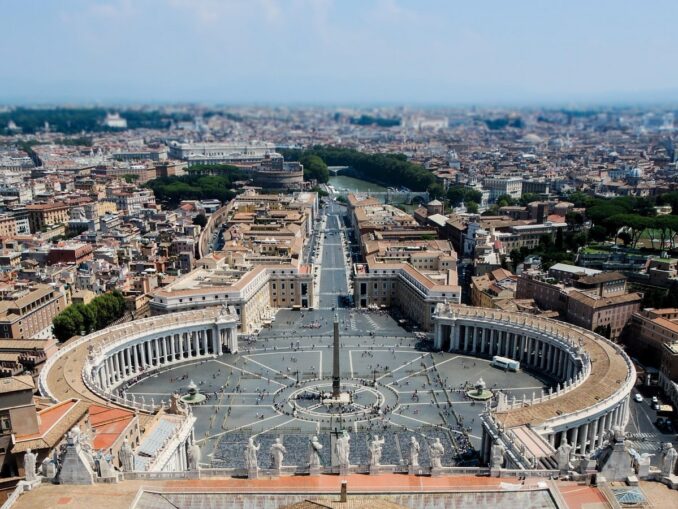
Tickets to the Vatican Museums should be purchased online and ahead of time – on a certain date. If you wake up during the season, say, a week before the expected visit, you may not find what you want.
Detailed information about the tickets is available on the official website of the Papal See.
Day 3
Surely you are tired of walking through ruins and museums. That’s why we recommend spending some time relaxing – walking around Rome can give you even more emotions than exploring its main attractions. In addition, the first does not exclude the second!
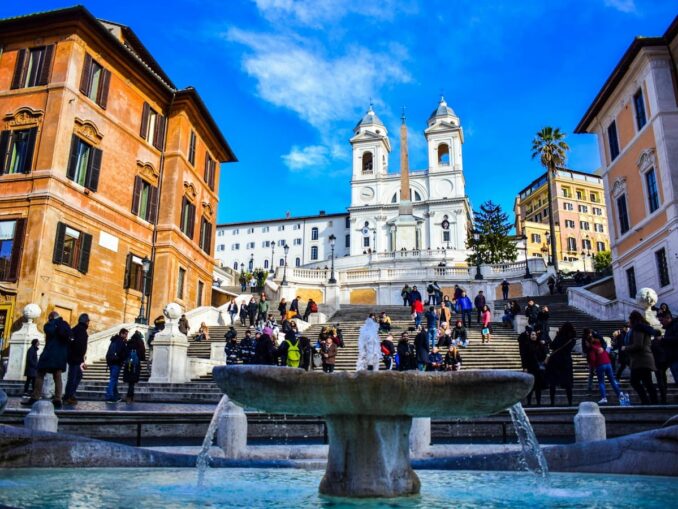
On day 3, we offer to see the following sights in Rome: Spagna metro station – Spanish Steps – Piazza Navona (1.3 km) – Pantheon – Temple of the Divine Hadrian – Trevi Fountain – Barberini station. The mileage of the route does not exceed 3 km. If you take your time and “hang out” in the places you like, you will be able to do it in 3-4 hours.
On the way, you can go to Rome… The Quirinal Palace. Once built for the Pope, it is now used as the official residence of the President of Italy.
The position is by no means decorative – the President of the Republic can, for example, dissolve parliament. Or “wrap up” the law by sending it for retrial. However, only once, for the second time, he is no longer able to veto…
Visiting the Quirinal Palace is a unique experience in many ways. It requires some preliminary preparation: you should book your participation at least 5 days in advance. And, by the way, one of the two existing sightseeing routes is almost free – you only need to pay a couple of euros for a seat reservation.
Day 4-5
It’s time to add some variety with a country trip, don’t you think? Or even several, why not? Because by day 4-5, the desire to see Rome weakens somewhat, and a change of scenery is required.
The simplest option is to visit the town of Tivoli, where the residence of Emperor Hadrian has been partially preserved. It is also visited by the Villa of the Dukes of Este, the fountains of the terraced park, which once inspired the Russian Peter I to create Peterhof.
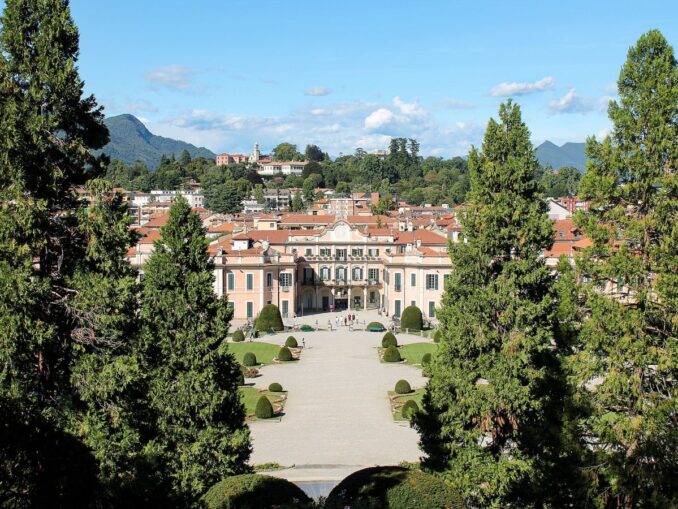
The mighty castle of Pope Pius II, dating from the second half of the XV century, the villa of Pontiff Gregory XVI and the ancient temples of Vesta and Sibylla are other popular attractions of Tivoli.
It takes 45-50 minutes by car to get to Tivoli from Rome, while a commuter train will take more than an hour to get from Tiburtina.
From Recently
promises a bunch of interesting impressions a trip to Castel Gandolfo. Cause today tourists can see not only the ancient town itself and enjoy the views of Lake Albano, but also visit the summer residence of the Pope with magnificent Barberini gardens.
It can be easily getting there on your own: by train from Termini, by bus from Ananyin Station. Every Saturday, a special train departs directly from the Vatican to the estate for a one-day tour.
In summer, you might want to go to the seaside. As the popular town of Lido di Ostia is only 30 km from the center of Rome. There are other less noisy and inexpensive resorts nearby.
Here – where to go on a seaside vacation in Italy.
Day 6
Villa Borghese is best left for a snack. Moreover, the visit time must be booked in advance – no more than 360 people can stay inside at a time: galleriaborghese.beniculturali.it/en/visita/info-biglietti/.
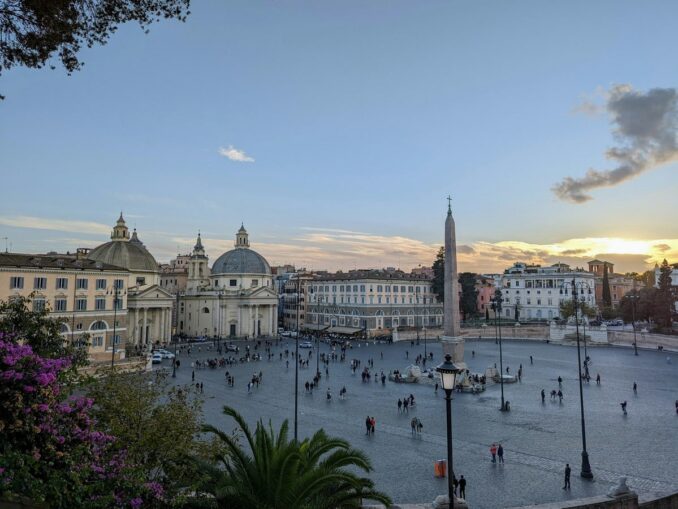
On the other side of the Pincio Hill, on which the Borghese Gardens are located, is one of the largest squares, Piazza del Popolo. Not too ancient (early 19th century), but impressive in its scope.
We recommend visiting the twin churches on the square, they date back to the end of the 17th century, the heyday of the Roman Baroque: Santa Maria dei Miracoli and Santo Maria in Montesanto.
Day 7
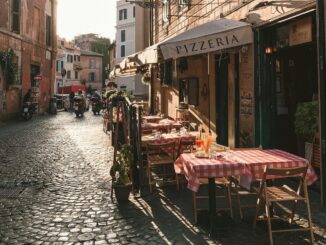
Once in Rome for a long visit, it is unwise not to visit the local extremely authentic Trastevere area. It is located on the western bank of the Tiber, and has largely preserved that cozy medieval flavor that is so dear to the traveler’s heart.
Wander through the streets, look at the houses, order pasta at one of the restaurants. This is what the Romans themselves do on weekends – why not follow the example of the locals?
By the way, it is in Trastevere that there is an excellent example of Renaissance architecture – Villa Farnesina. Inside, you can see not only the rich interiors, but also the incomparable frescoes by Raphael. Tickets with an audio guide are very inexpensive.
Well, for a snack, we recommend personally seeing the unusual sights of Rome – the Coppede quarter. It is located in the northeastern corner of the great city, accessible on foot from Policlinica Metro station (line B).
What is a Coppede? This is a whole large block built up with houses in the Liberty (Italian Art Nouveau) style. Great photos can be viewed, for example, here – rozik1965.livejournal.com/92920.html.
It is estimated that the area is home to 45 beautiful examples of “high” architecture, built in 1916-1927. There should have been even more, but the author of the project, Florentine architect Gino Coppede, died unexpectedly, without fully implementing the project.
Be sure to go there when you are in Rome. Moreover, there are very few tourists in the Koppede quarter to this day!
- Which month is the best to go to Rome
- How to get from Rome to Florence fast
- How long to travel by train from Rome to Venice
© Eurotraveler