Rome Metro: scheme, opening hours, ticket prices 2026, travel passes. How to use the subway in the Italian capital, stations near the sights. The nuances that you should know about taking the metro in Rome, useful tips – in the Eurotraveler review.
As you can probably guess, there is a metro in Rome. However, it is still completely underdeveloped for such a large metropolis. And in terms of size (there is nothing to say about the cleanliness of the stations), it is inferior, for example, to the Stockholm metro, a city with a much smaller population and a more modest number of tourists.
Nevertheless, of course, the Roman subway is an absolutely indispensable transport system that allows you to move quickly in the city center. In addition, it is installed in the railway communication system.
In particular, you can quickly get to Rome from Fiumicino or Ciampino airport and continue your journey by metro. You just need to take into account the mode of its operation – more on that below!
It’s worth remembering that you can’t actually get to the city by metro from Rome’s airports: only by special Leonardo Express train or bus routes.
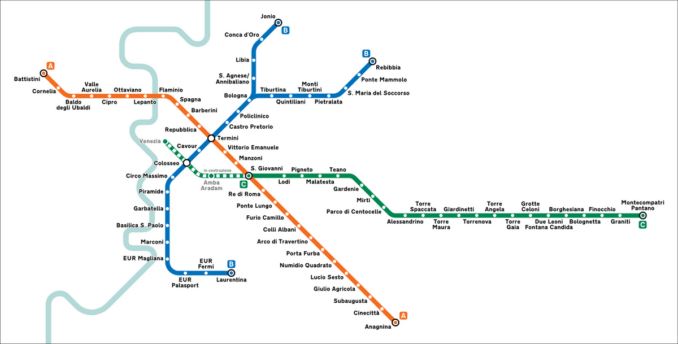
In 2026, the Rome metro system has 74 stations on 3 lines: A (orange), B (blue) and C (green). The first two intersect at the terminus of Termini, the third (as intended) passes under the main attractions and goes far beyond the city. The construction of some of the more than 30 stations on Line C is still incomplete.
Rome Metro Map
Schedule
From Sunday to Thursday, the Rome Metro opens for passengers at 5.30 am and runs until 23.30. But on Fridays and Saturdays it is open from 5.30 to 1.30 am. This is mainly due to the fact that the Romans themselves like to sit in cafes and restaurants on the eve and on weekends and often stay well after midnight (other interesting traditions of Italy are in our separate article).
The interval of train movement in the Rome subway is from 1 to 3 minutes during peak periods. Outside of them, it will take 10-15-20 minutes to wait for the arrival of the train, depending on the line.
Fares and Tickets 2026
The fare for the Rome metro has been unchanged for many years – you can buy a ticket for 1.5 euros. Moreover, it gives the right for 100 minutes not only to ride in the dungeons under the Italian capital, but also to use other types of public transport.
It is only necessary to take into account that after leaving the subway, you will be able to go there again only with a new ticket. Children under the age of 10 have the right to free travel on the Rome metro. This distinguishes it from most of its European counterparts, where you can avoid paying for a child’s travel only up to 6-7 years old.
There is also a system of travel passes in the Rome metro system, which allows you to save a lot on trips. Tickets for 24 hours are valid without restrictions on the number of trips and cost €7, for 48 hours – €12.5, for 72 – €18, for 7 days – €24.
You can also buy a travel card for 10 trips at once – for €15. You can (try to discover) more information on the official website of the Roman transport system – atac.roma.it. Strangely structured and clearly not at all concerned with the convenience of potential users…
Both single-use tickets and travel passes are purchased at vending machines that are installed at all stations of the Rome subway. You can pay for the trip either in cash (including coins) or by bank card.
There are also surprises: the ticket vending machine in the Rome metro may refuse to accept not only cards, but also paper bills. In this case, experienced travelers recommend always keeping 1 and 2 euro coins in your wallet.
To enter the platform, you need to pass through the turnstiles, which are tall glass gates, a kind of fence. To do this, insert the ticket in accordance with the direction of the arrow printed on it into the turnstile slot under the yellow circle.
The machine will stamp it according to the time and place of the start of the trip. Without this, the tickets are considered invalid, and you can be fined, despite all your decency and law-abiding.
Important Stations
In order for you to get a better sense of direction when designing your route to see the best sights of Rome, we will tell you about the most popular stations.
On Line A
this:
Termini is a hub interchange station between lines A and B, located under the main railway station of the Italian capital. From here you can easily get to Fiumicino Airport.
As well as getting from Rome to Milan, Florence, Venice, Naples. Yes, in principle, any city in Italy to which trains run.

Termini is also a hub station for other public transport routes in Rome: buses, trams and trolleybuses. As for the sights, nearby is the Palazzo Massimo and the Baths of Diocletian, which are part of the National Museum of Rome. Those who want to see inside and out (admission is free) the amazing church of Santa Maria Maggiore will have to walk a little way.
The Vittorio Emanuele station, one stop from Termini, is responsible for quick access to the park of the same name and the Esquilino food market, which today is no longer at all Italian and crowded with migrants. It also provides quick access to Santa Maria Maggiore.
Barberini
It is located under the square of the same name in the heart of the Trevi district. After leaving here, you will be able to get to the beautiful art museum in Palazzo Barberini in a couple of minutes.
And in 5 minutes you will reach Piazza Navona, a must-see square in Rome. In 8-10 minutes, tourists from Barberini station can easily reach the Trevi Fountain. You’ve probably heard of him, too…
You will almost certainly not miss the
Spagna Station
Especially, if you come to the Italian capital for sales. Because it is the starting point of popular shopping routes in shops and boutiques on Via Condotti, Frattina and Borgognona. Hiking along Via del Corso usually starts from here.
Using the exit at this station, you will get to the Piazza di Spagna with the famous staircase, you will be able to explore the Trinita dei Monti church and reach the Pinciana Gate, behind which the park and the Borghese Gallery are hidden. The latter, as you know, is one of the most famous and popular art museums in Rome.
Others
Flaminio-Piazza del Popolo serves the main square of the Italian capital, as well as the Campo Marzio quarter.
Ottaviano is like the gateway to St. Peter’s Basilica and the Vatican museums. It is located at the intersection of Julius Caesar Avenue and Octavian Street.
We will also mention such a little-known but useful shopping station as Lucio Sestio. It is located on the outskirts, approximately in the middle of Tuscolan Street.
The latter is well known to the Romans, as it houses a lot of clothing and shoe stores. With prices that are often an order of magnitude lower than what you’ll find in boutiques near Spanish Square.
Line B
Tiburtina is the second largest railway station in Rome. Regular regional and high-speed trains “Krasnaya Strela” (Frecciarossa) depart from here.
You can also get to Fiumicino Airport from Tiburtina (as well as from Termini): by bus or, which is twice as expensive, by Leonardo Express train.

Cavour station serves the first Roman district, Monti, from the north hugging the Roman Forum and Palatine Hill. And in principle, they can also be chosen as an “access point” to what you need to see in Rome in the first place, like the Colosseum.
A landmark place near Cavour station is Piazza della Madonna dei Monti. And the Via del Boschetto leading to it was officially recognized as the richest street in restaurants in Rome. And to taste some typical Italian dish on it is just a “must have” for a tourist.
You should also visit the beautiful Basilica of Santa Maria Maggiore nearby (go the other way). All you have to do is climb Capitol Hill.
Monti Market is open in the area on weekends. Where you can buy original Italian souvenirs as a gift to your family and friends. And, in principle, to purchase vintage items that have become out of fashion.
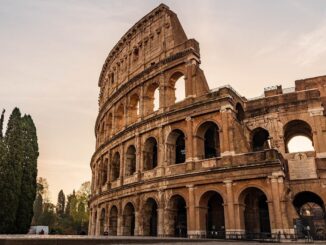
Colosseo is another central metro station in Rome. It is through her that tourists get to the Roman Forum and the Colosseum.
What Else
Circo Massimo Station is named after the largest ancient Roman circus, which was larger than the Flavian Amphitheater, that is, the well-known Colosseum. Nearby are the Baths of Caracalla.
It is from this metro station that it is most convenient to walk to the Aventine Hill and the Orange Orchard (Giardino degli Aranci). In order to look through the famous keyhole on the Aventine, through which three states are visible at once.
Taking bus 118 at Circo Massimo station, you will reach the (modern) beginning of the Via Appia. Initially, this most important transportation highway of Ancient Rome began directly from the circus.
The Piramide is located under the Ostiense Square in the area of the same name. It got its name thanks to the pyramid, which served as the mausoleum of Gaius Cestius.
Today, Pyramid station is an important transport hub, installed in the railway network. In particular, commuter trains to Lido di Ostia depart from it. A popular beach resort on the Tyrrhenian Sea, a summer vacation destination for Romans and tourists.
- When is the best time to fly to Rome: weather by month
- What is the fastest way to get from Rome to Florence
- What should foreigners be afraid of in Italy
© Eurotraveler