What does the vaporetto mean to Venice? Route map, schedule, fare prices for 2026, and ticket discounts. How to get from the airport to St. Mark’s Square and Murano, San Giorgio Maggiore, and the Lido by vaporetto, as well as from Piazza Roma, Santa Lucia Station, and the Tronchetto ferry terminal -read about it in this Eurotraveler article.
There is a common belief that Venice is a small city that should be explored exclusively on foot. And online, you can find statistics supporting this view: it takes 20 minutes to walk from the train station to the Rialto Bridge, and another 10 minutes to reach St. Mark’s Square.
However, in reality, it’s much more exhausting. So if you didn’t originally plan on taking a walking tour of Venice, we recommend not passing up the chance to save your energy.
You’ll need that energy for long walks and patiently standing in lines at the “Most Serene Republic’s” popular attractions. By the way, these lines form even during the off-season…
Again, the only way to reach Murano, Burano, Torcello, and the other islands in the Venetian Lagoon is by vaporetto. You can, of course, take any other boat as well. But that will cost significantly more…
What is the Vaporetto?
In short, it’s Venice’s public transportation. A natural substitute for buses, trolleybuses, trams, and the metro in the local context.
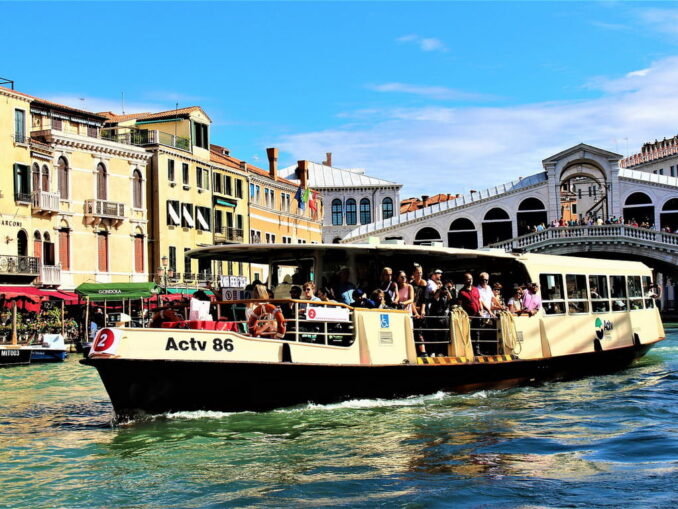
Visually, the vaporetto looks like a fairly large passenger boat. The route number is written on the bow, and the name of the operating company—ACTV—appears on the sides.
There are seats on board, but you’ll often have to stand. And consider yourself lucky if you can stand outside rather than inside—there are plenty of people eager to take in the sights in good weather!
You should decide in advance which side of the boat to board (if possible) by checking a city map (€3, available at the train station).
For example, Ca’ Pesaro is located on the right side of the Grand Canal when traveling from the train station and before the Rialto Bridge, while Ca’ Rezzonico is on the same side but after the bridge. At the same time, to see Ca’ d’Oro or Palazzo Cavalli-Franchetti, you need to look to the left as you head toward San Marco.
The vaporetto stops look like large glass-enclosed kiosks. They have a small waiting area, ticket counters, and timetables posted on the walls.
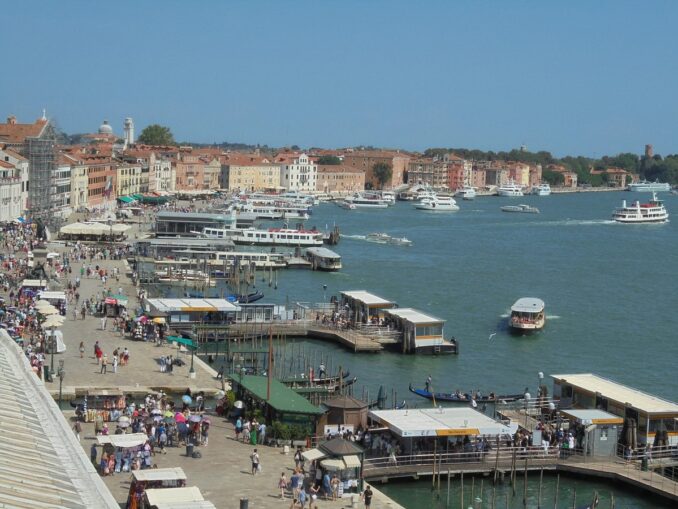
Passengers
enter through the turnstiles by tapping their pass or ticket on the reader, known as a validator.
Pay attention to the vaporetto route numbers (displayed in a prominent place) served by these kiosks. There are four or five of them on the waterfront near Santa Lucia Station, and it’s easy to get confused if you’re not used to it.
A distinctive feature of the vaporetto: a burly man or even a woman pulling the boat up to the pier with a rope and lowering the gangway, along which crowds with suitcases move on and off the boat.
Sometimes the mooring attendants check tickets by holding them up to a special reader. This doesn’t happen often: over the course of 2–3 days traveling around Venice, you might encounter a ticket check only once.
Routes
Vaporetto No. 1—a route starting from Piazza Roma, traveling along the Grand Canal with stops near: Ferrovia (Santa Lucia Station), the Rialto Bridge, the Accademia, Santa Maria della Salute, St. Mark’s Square and Basilica, the magnificent Doge’s Palace, and finally arriving at the island of Lido.
Route No. 1 is recommended to tourists by all official local guidebooks. It’s worth noting that the boat on this route stops at EVERY pier along the way.
This wastes an unacceptable amount of your travel time. The trip to St. Mark’s Square on Vaporetto Route 1 takes 45 minutes—it’s faster to walk!
Route No. 2 is much more convenient. It also goes to San Marco, but does so faster, since it doesn’t stop every couple of minutes.
In addition, Route No. 2 can pick up tourists not only at the train station and Piazzale Roma, but also earlier, from Tronchetto. This is where the ferry terminal and a huge parking lot are located.
Attention!
Route No. 2 does not stop at Salute! To visit the Basilica of Santa Maria della Salute, you need to get off a little earlier, at the Accademia stop. And while you’re at it, you can stop by the Accademia Gallery—the city’s main art gallery.
A little further along the route toward the Basilica of Santa Maria della Salute, there’s another art museum—the private Peggy Guggenheim Collection. It’s worth noting that the paintings there are quite unique—the entire collection is dedicated exclusively to modern art.
Keep in mind that Vaporetto No. 2 follows a circular route. This means that from the station, you can take it either left along the Grand Canal or right along the Giudecca Canal.
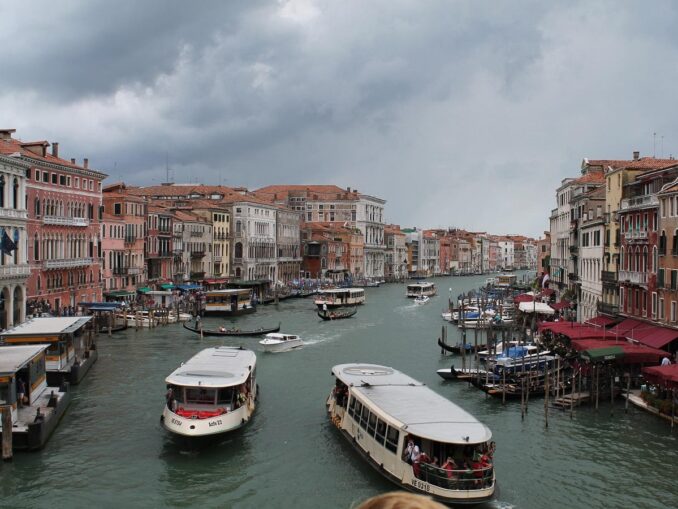
Taking a Boat
across the canal and past Giudecca Island allows you to reach the island and the famous Church of San Giorgio Maggiore directly, as it were, from a slightly different angle of Venice. And in far more comfortable conditions—you’ll likely be sitting rather than standing as you admire the views.
You can take Vaporetto No. 3 from Santa Lucia Station to Murano Island. But you won’t be able to reach Burano or Torcello on a water bus with the number 3 on the bow—be careful! Only No. 12 goes to these islands!
Routes 4.1 and 4.2 arrive at Murano after a series of stops on the “back side” of Venice (Fondamenta Nova) and the islet of San Michele, where the local cemetery is located.
Here is an affordable sightseeing tour in English to Murano and Burano from Venice.
Routes 5.1 and 5.2 are circular, allowing you to travel from the train station and Piazza Roma to Lido and back.
The first goes through the Giudecca Canal and returns via Fondamenta Nova. The second runs in the opposite direction—through the Cannaregio Canal and then along the northern side of the main island. Neither enters the Grand Canal. But they both stop at San Zaccaria.
No. 12 – Fondamenta Nova – Murano – Mazzorbo – Burano – Torcello
N – night route
Read our separate article to find out how to get to Venice quickly from the airport!
Comfort and Passenger Numbers
There are many passengers on the popular routes No. 1, 2, and 3. And don’t think you’ll be sitting with your legs crossed, gazing at the passing scenery!
Seats get snatched up in a flash, just like on the Moscow Metro. And no one will give up their seat for a child—that kind of courtesy isn’t in style in egalitarian Europe!
By the way, there are restrooms on board. And you don’t have to pay extra to use them. Surprising, since a similar service in Venice itself costs at least €1.50.
Vaporettos are often packed to the brim with passengers. The real chaos sets in toward evening, when tourists rush to leave the San Marco area and swarm the pier near the Doge’s Palace.
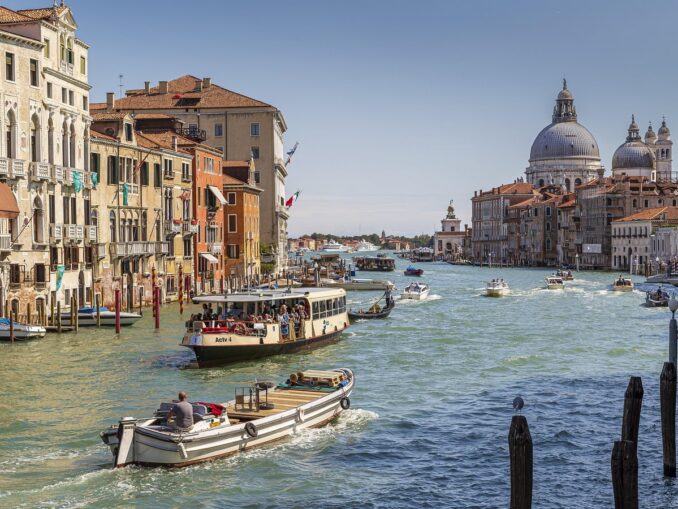
It’s rush hour: everyone is literally packed shoulder to shoulder, clinging wearily to the handrails and oblivious to the beauty around them.
Here’s what tourists should see first in Venice.
Fares
Everything is transparent here, though it is expensive – especially since 2024. A single-ride ticket for the vaporetto costs €9.50 (the previous price, which remained unchanged for a decade, was €7.50) and is valid for 75 minutes from the moment of validation.
No discounts are available, and seniors are no exception. Children’s fare on the vaporetto is governed by the following rule: free for ages 0–5, then standard rates apply.
If you plan to take the vaporetto twice within the specified time frame, temper your enthusiasm. These boats don’t race like rockets and stop at every scheduled stop.
Purchasing a VENEZIA DAILY PASS can save you a significant amount of money—if you plan to take the vaporetto more than twice. Specifically, in 2026, a 1-day (24-hour) pass costs €25, a 2-day pass costs €35, a 3-day pass costs €45, and a weekly pass costs €65.
Passengers aged 6–29 can apply for a Rolling Venice discount card (passport or ID required). After that, the pass will be sold at a discount: €33 for 3 days – veneziaunica.it/ru/e-commerce/services.
Similar vaporetto passes, including a round-trip to Marco Polo Airport, cost:
€30 – 24 hours
€65 – 72 hours.
For reference
a one-way trip from the airport to Venice (airport bus + vaporetto, ticket valid for 90 minutes from the time of boarding) costs €18.
The route map is available here: muoversi.venezia.it/mappa_linee.pdf.
You can calculate the travel time from the airport to St. Mark’s Square, the Rialto Bridge, Murano, or Burano using the schedule posted on the official Alilaguna website: www.alilaguna.it/en/lines/line-timetables.
For reference: the water bus from Marco Polo Airport takes 55 minutes to reach the Rialto pier and 1 hour and 15 minutes to reach St. Mark’s (Linea ARANCIO). On the BLU line, the boats take a shorter route (38–40 minutes) and dock at the Fondamenta Nova pier.
A one-way ticket on the vaporetto from the airport to Venice costs €15, and to Murano, €8. All fares: www.alilaguna.it/biglietti/tariffe.
Where to Stay
We put this paragraph right here for a reason! You need to understand that how often you’ll take the vaporetto depends directly on where you stay in Venice.
For example, hotels in the San Polo district are within walking distance of the Santa Lucia train station. And for anyone arriving by train or bus, it’s easier to roll your suitcases to your hotel or apartment in 10 minutes than to wait for a water bus.
Staying here in an apartment—a luxurious, though by no means budget-friendly option—will cost you between €150 and €200 per night (plus city tax), depending on the month. That is, of course, if you’re not willing to compromise and want to stay in comfortable accommodations.
Finding accommodation in the Cannaregio district, adjacent to the train station, is equally convenient for those arriving by train and those arriving by plane. Since the Alilaguna A route, departing from Marco Polo Airport, cuts this district in two, then flows into the Grand Canal and heads straight to San Marco.
In Mestre, we recommend checking out the affordable (from €80 per night for two) and perfectly located Hotel Delle Rose. It offers convenient access to both the airport and Venice itself (tram line T1). There’s also a supermarket nearby; if you like, you can buy so much delicious (and healthy) food that you won’t be able to eat it all during your entire stay.
And yes—remember that the “City of Canals” is an extremely popular destination. Even on off-season weekends and holidays, it’s almost overwhelmed by arriving Italians. Affordable and good hotels get booked up 3–4 months before your desired dates, and so… well, you get the idea.
That digression—albeit an important one—is over. Let’s continue… with the vaporetto!
What you need to know
Note that it’s not always possible to get by with just a single vaporetto ride. While you can reach Murano on the “No. 3,” only the No. 12 runs to Burano, departing from the Fondamente Nova pier. To get there from the same station, by the way, you’ll need to take another ride… or walk.
It makes sense to take a photo of the water tram schedule in advance so you know whether and where to rush when transferring. Since not all routes depart from the same terminal (kiosk).
For example, we arrived in the evening from Burano at the Faro (Murano) stop. From the other pier, route 4.1 (not direct) departs literally 1–2 minutes later.
Some people rushed off. But if you’re heading back to the station, it’s worth waiting for the non-stop boat with the number 3 on board.
Here you can read how to get to Venice by train—from Mestre as well as other Italian cities, such as Treviso.
- What souvenirs and food to buy in Venice as gifts
- Driving through Italy—what you need to know
- How to get from Venice to Verona and what to see there
© Eurotraveler